By Mr Pavel Akimau, Consultant Trauma and Orthopaedic Surgeon. MBBS, PhD, FRCS (Tr & Orth). GMC 6100148. University Hospitals of North Midlands NHS Foundation Trust.
Bunions are one of the most common reasons people walk into my clinic. Most of them have been putting up with the problem for years before they come and see anyone about it. They have tried wider shoes, gel pads, splints they bought online, and a great deal of hope that the lump might somehow shrink on its own. It will not, and the conversation we end up having is usually less about whether to do something and more about when.
I am a consultant foot and ankle surgeon based in Staffordshire, with private clinics in Cheltenham and Bristol. Bunion correction is the single operation I do most often, and over the past few years I have moved my entire practice across to a minimally invasive technique that did not exist in most UK hospitals a decade ago. This guide is the longer version of the conversation I have in clinic. It covers what a bunion actually is, what works for it (and what does not) before surgery, how the modern keyhole operation differs from the old one, what realistic recovery looks like in 2026, and how to know when you have crossed the line from “it’s a nuisance” into “it’s time to do something”.
This article is for information only. It does not replace a face-to-face consultation. A treatment plan for a bunion depends on the X-rays, the shape of your foot, your activity level and your goals not on what worked for your friend.
What this guide covers
- What a bunion actually is (and why it is not just a bump)
- Why bunions happen and what does not cause them
- Non-surgical bunion treatment: what works, what is marketing
- When the right time for surgery is
- Modern minimally invasive bunion surgery, explained honestly
- Traditional open bunion surgery, and where it still has a place
- Recovery week by week
- Risks, complications, and recurrence rates
- Frequently asked questions
What a bunion actually is
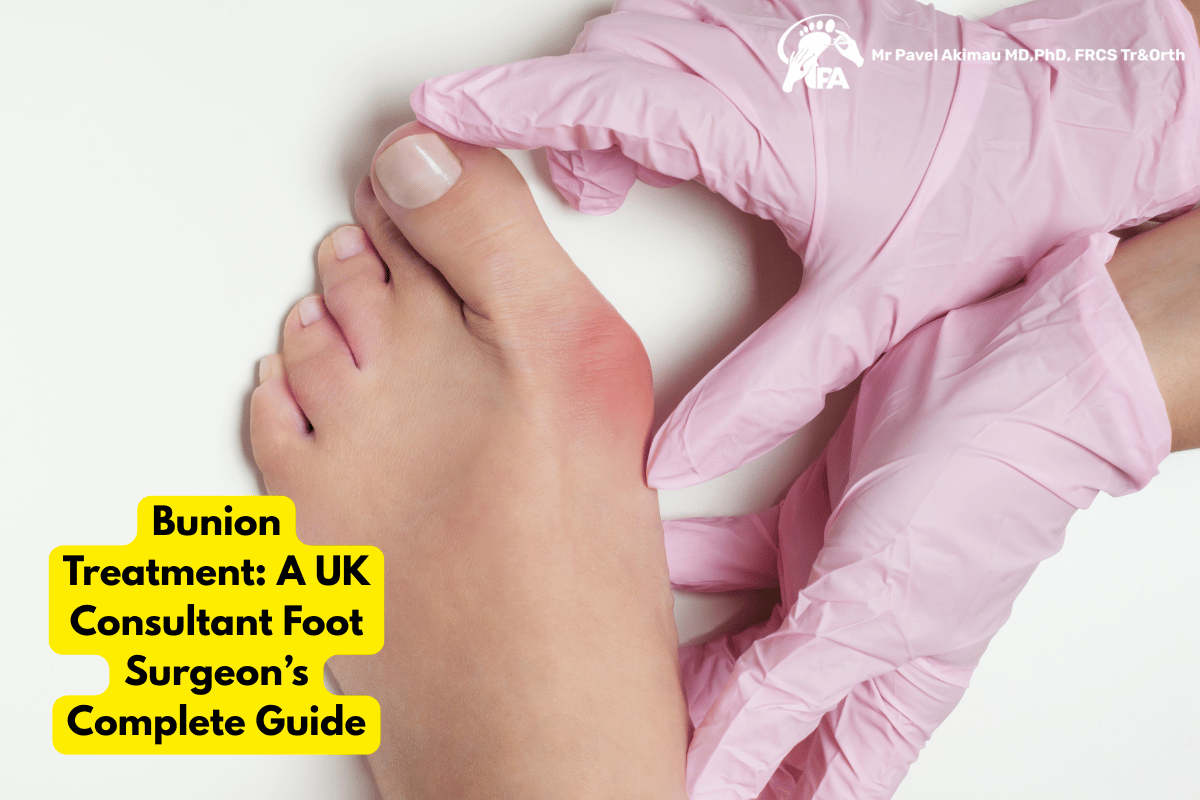
The medical term for a bunion is hallux valgus. The bump on the side of the foot that everyone notices is only part of the problem. What is actually happening is that the first metatarsal the long bone behind your big toe has drifted outwards, while the big toe itself has angled inwards, towards the second toe. The bump is just where the head of that drifted metatarsal pushes against the inside of your shoe. The deformity is in the alignment of the bones underneath.
This matters because it changes what treatment actually involves. Shaving off the bump alone which used to be called a bunionectomy and is still occasionally offered leaves the underlying misalignment intact and the bunion comes back. A modern bunion operation, whether done open or with keyhole instruments, has to do two things: realign the bones, and stabilise them in the corrected position with a small implant. That is why a properly done bunion correction lasts, and a shaving operation does not.
Around one in three people over the age of 65 have bunions to some degree. Women are affected roughly twice as often as men. It is partly a genetic problem (most patients I see have a parent or grandparent with the same foot shape) and partly a problem of how the foot is loaded over decades. Tight shoes do not cause bunions on their own, but in a foot that is genetically predisposed they accelerate the process and they certainly make it more painful.
Why bunions happen and the myths
The two most common questions I get in clinic are “did my shoes do this?” and “is there anything I can do to stop it getting worse?” Both deserve a straight answer.
Genetics is the dominant factor
If one or both of your parents had bunions, you are significantly more likely to develop them yourself published series put the figure at around 70%. The shape of the bones, the laxity of the ligaments around the first toe joint, the way the foot loads when you walk these are all heritable. This is why I see bunions in young, otherwise fit patients who have never worn a heel in their life, and why I see grandmothers who wore tight shoes all their working life and never developed one.
Shoes accelerate, they do not cause
Narrow, pointed shoes squash the toes inwards. In a foot that is genetically predisposed, that constant inward pressure accelerates the development of the deformity and makes it symptomatic earlier. In a foot that is not predisposed, the same shoes will be uncomfortable but will not produce a bunion. The honest answer to “did my shoes do this” is usually “they did not help, but they are not the whole story.”
Other contributors
- Joint laxity (hypermobility), which loosens the support around the big toe joint
- Flat feet, which change how load passes through the forefoot
- Inflammatory arthritis, particularly rheumatoid arthritis
- Pregnancy, because of the hormonal effect on ligament laxity
- Occupations that involve long hours standing or repetitive forefoot loading
Myths I hear most often
- “Toe spacers will fix it.” They will not. They may make the foot feel more comfortable in the short term, but they do not reverse the underlying bone alignment. Years of taping or splinting will not straighten a true bunion.
- “Bunion exercises can cure a bunion.” They can help with foot mechanics, calf tightness and arch support all useful but they cannot move a metatarsal back into position. They are part of conservative management, not a cure.
- “If I leave it long enough, the bone will reshape itself.” Bunions get worse over years, not better. Without intervention, the deformity progresses, the second toe gets pushed out of position, and the joint cartilage starts to wear out. Waiting too long makes the eventual operation bigger, not smaller.
Non-surgical bunion treatment: what works
Most patients I see have already tried some form of non-surgical bunion treatment by the time they reach me. For a lot of them it has bought useful time. For others it was the wrong tool for the job. Here is what the evidence actually supports, ranked roughly in order of how useful I find each measure in clinic.
Footwear that respects the shape of your foot
The single biggest comfort change a bunion patient can make is shoes with a wide, deep toe box. Not just a wide shoe overall specifically a wide toe box, where the front of the shoe is shaped to give the toes room to spread. Brands that build shoes around a wider last (Altra, some Hoka and New Balance models, Birkenstock professional ranges, Vivobarefoot) are worth knowing about. Trying shoes on at the end of the day, when feet are at their largest, is a small habit that saves a lot of returns.
Orthotics and insoles
A well-made orthotic does not cure a bunion, but it can reduce the load through the painful first toe joint, support a fallen arch, and make daily walking comfortable. Over-the-counter insoles work for some patients; others need custom orthotics made by a podiatrist after a proper foot assessment. I refer to a podiatrist before I refer for surgery in most cases, because if an insole can keep you comfortable for another five years that is five years of avoided operation.
Bunion pads and toe spacers
Silicone toe spacers between the first and second toe, gel pads over the bunion itself, and bunion sleeves all reduce day-to-day rubbing. None of them straightens the toe. They are comfort aids, not corrective devices, and they are perfectly reasonable to use just do not expect them to do anything they cannot.
Night splints
These hold the big toe in a corrected position while you sleep. There is some weak evidence they slow progression in very early, flexible bunions. In an established bunion they are uncomfortable and not effective. I do not recommend them as a treatment for an established deformity.
Anti-inflammatories and ice
For an acute flare a bunion that has suddenly become red, swollen and painful, often after a long walk or a new pair of shoes a short course of ibuprofen or naproxen and an ice pack can settle the bursitis around the joint within a few days. This is symptomatic relief, not a treatment for the bunion itself.
What I do not usually recommend
- Steroid injections directly into the bunion. They can offer short-term relief but do not change the deformity and repeated injections can damage the joint cartilage.
- Online “bunion correctors” sold as a non-surgical alternative to surgery. Most are well-marketed toe spacers. None of them realigns bones.
When the right time for surgery is
There is no fixed point at which a bunion needs to be operated on. Plenty of people live with a visible bunion all their lives and never need surgery, because it does not hurt and it does not stop them doing what they want to do. The question is not how big the bunion is it is how much it is interfering with your life.
These are the situations where surgery becomes a genuine conversation in my clinic:
- Daily pain that interferes with walking, standing or sleep
- Shoes that have become genuinely difficult to wear, or that you have to buy in a size larger than you need
- Visible progression of the deformity a bunion that is clearly bigger this year than last
- The second toe being pushed out of position by the drifted big toe, sometimes lifting up over the top of it
- Painful callosities on the ball of the foot, where the second metatarsal is now taking load it was not designed for
- Pain that has become arthritic in character stiff first thing in the morning, worse with activity which suggests the joint cartilage is wearing out
The thing I want patients to understand is that bunion surgery is not cosmetic in any meaningful sense. People sometimes apologise for being “vain” about wanting their bunion sorted, and they should not. A bunion that is painful enough to come and see a surgeon about is a mechanical problem affecting how the foot loads, and waiting longer almost never makes the operation simpler.
Modern minimally invasive bunion surgery, explained
I have moved my entire bunion practice across to a minimally invasive (MIS) technique, and there is a reason for that. The old open operation works but it leaves a scar of several centimetres on the inside of the foot, involves separating soft tissues that the MIS technique leaves alone, and produces a recovery that most patients remember as harder than they expected. The MIS technique gets the same correction through four or five incisions, each smaller than a grain of rice. The operation itself takes longer to learn but is less destructive to do. Recovery is measurably easier.
Here is what actually happens, in plain language.
How the operation works
Under anaesthetic, four or five tiny skin punctures are made around the first toe and metatarsal. A high-speed surgical burr a miniature drill is introduced through one of those punctures to make a clean cut across the first metatarsal bone. Through another puncture, the head of the metatarsal is slid sideways into a corrected position. The bones are then held in place with two or three small titanium screws, also placed percutaneously. The screws stay in for life unless they cause irritation, which is rare. The whole operation is done under live X-ray guidance, so the surgeon can see the alignment improve in real time.
Why patients prefer it
- Smaller incisions, smaller scars. Most patients have nothing more visible than four faint dots once healing is complete.
- Less soft-tissue disruption. The MIS technique works through the bone without lifting flaps of skin or detaching tendons, which is the part of the open operation that causes most post-operative pain.
- Walking on day one. Patients can put weight through the heel and outer side of the foot in a special post-operative sandal from the day of surgery. They are not bed-bound.
- Less post-operative pain. The combination of smaller incisions and less soft-tissue trauma means most patients describe the post-operative period as significantly less painful than they expected.
- Faster return to normal shoes. Most patients are back in trainers between four and six weeks, and in normal shoes by eight to ten weeks. With the older open techniques, that timeline was often double.
Where the MIS technique is most useful
The minimally invasive approach handles the full range of bunion severity, from mild to severe. The myth that MIS is only for small bunions is exactly that a myth, dating from the first generation of percutaneous techniques in the 1990s. Modern third-generation MIS techniques (the ones I use) correct severe deformities reliably. The correction achieved on the X-ray is as good as the open technique in published series.
When MIS might not be the right answer
Being straight with you, MIS is not the answer for absolutely everyone. The situations where I will still recommend an open operation are:
- Severe arthritis of the first toe joint, where the right answer is joint fusion or replacement rather than bone realignment
- Bunions with a significant rotational deformity at the great toe that requires direct soft-tissue work
- Revision surgery where previous open hardware needs to be removed and addressed
- Patients with poor bone quality or unusual anatomy where percutaneous fixation is not safe
In an average year, around 95% of the bunion patients I see are suitable for the MIS technique. The remainder, I will tell you honestly that an open operation is the better operation for your specific foot, and explain why.
Traditional open bunion surgery: where it still has a place
Open bunion surgery (most commonly a scarf osteotomy or a chevron osteotomy) has been the standard UK operation for about thirty years. It works. The deformity correction is reliable, the long-term outcomes are well published, and most foot and ankle surgeons in the UK have done thousands of them. If you have already had advice for an open operation from a surgeon you trust, you are not being offered a bad operation.
The trade-offs against MIS are these:
- A longer incision (around 5 to 7 cm) on the inside of the foot, with a visible scar that fades but does not disappear
- More post-operative pain in the first two weeks, because of the soft-tissue work involved
- A slightly longer time in the post-operative sandal (typically 6 weeks) before transitioning to normal shoes
- A higher reported rate of wound healing problems, particularly in diabetic or smoking patients, simply because the wound is bigger
On long-term correction will the bunion stay corrected ten years on the published evidence shows the two techniques are essentially equivalent in well-selected patients. The difference is in the recovery, not in the result.
Recovery week by week
This is the section patients reach for first when they read about bunion surgery, and it is the section where I have learned to be very specific. Vague timelines lead to disappointment. Here is what I tell my patients to plan for after the minimally invasive operation.
Day of surgery
Day-case procedure under general or regional anaesthesia. Home the same day. Foot is wrapped in a soft bandage that holds the toe in the corrected position. Patient walks out of hospital in a post-operative sandal that loads the heel and outer foot rather than the forefoot. Crutches are usually offered for the first 24 to 48 hours for stability rather than because weight-bearing is forbidden.
Week 1
Foot up as much as practical above the level of the hip for at least 18 hours a day in the first three days. This is the single biggest thing patients can do to reduce swelling and pain. Walking is fine in the sandal, but in short distances around the house. Most patients are off any strong painkillers by day three or four.
Week 2
First clinic follow-up. The bandage is changed, the wounds checked (no sutures usually need removing as they are absorbable). Most patients have stopped using crutches by this stage. Driving is not advised yet.
Weeks 3 to 4
Sedentary office work is possible, often from home initially. Most patients can drive an automatic car by the end of week 3 if the surgery was on the left foot, and by week 4 for the right foot with the caveat that you must be able to perform an emergency stop comfortably.
Weeks 4 to 6
Transition out of the post-operative sandal and into a wide, soft trainer. X-rays at six weeks confirm bone healing. Light cross-training (cycling, swimming, upper body in the gym) is fine from this point if the wounds are well healed.
Weeks 8 to 12
Most patients are back in normal shoes fashion shoes still feel tight because the foot is still gently swollen at the end of the day, which can persist for several months. Return to walking holidays, hill walking and easy jogging is reasonable from around the 12-week mark.
Months 4 to 6
Full return to running, racquet sports and dance. The foot continues to refine its shape and the residual swelling settles. The fading of the small scars becomes obvious by this point.
Twelve months
This is the point at which I assess the final result with the patient. By twelve months, the foot looks and feels as it is going to look and feel.
Risks, complications and recurrence
Every operation has risks, and bunion surgery is not an exception. The honest figures, taken from published series and from what I see in my own practice, are these.
- Infection. Around 1 in 100 patients develop a superficial wound infection that settles with oral antibiotics. Deep infections requiring further surgery are much rarer, well under 1%.
- Wound healing problems. Lower with the MIS technique than open surgery, because the incisions are tiny. The risk rises in diabetic patients and in smokers, and I will discuss optimisation before booking surgery in either group.
- Nerve irritation. A small sensory nerve runs close to the bunion area. Numbness or altered sensation on the inside of the big toe is reported by around 5–10% of patients and is usually temporary.
- Stiffness. Some loss of the upward bend of the big toe is common after any bunion operation and is one of the reasons we do not operate on every bunion. In most patients it does not interfere with normal walking.
- Recurrence. Around 5–10% of bunions recur over the decade following surgery, in any operation. The recurrence rate is influenced more by patient anatomy and adherence to post-operative footwear advice than by the choice of technique.
- Over-correction or under-correction. Rare, well below 5% in experienced hands, and usually correctable if it occurs.
- Hardware irritation. The small screws used to hold the correction occasionally need to be removed if they cause discomfort. This is a minor day-case procedure and is required in around 2–3% of patients.
- Deep vein thrombosis. Rare in foot surgery but not zero. I assess every patient for risk and prescribe a short course of blood-thinning prophylaxis when indicated.
These numbers are not meant to put you off. They are meant to give you the same information I would want if it were my foot. The published outcomes for modern bunion correction are good, satisfaction rates sit consistently above 90% in well-selected patients, and the trade-off most people find acceptable is a few weeks of inconvenience against a problem they have been living with for years.
Frequently asked questions
What is the most effective bunion treatment?
For an established, painful bunion, the only treatment that corrects the underlying bone alignment is surgery. Non-surgical bunion treatment wider shoes, orthotics, toe spacers, anti-inflammatories can manage symptoms and slow progression in some patients, but no conservative treatment reverses the deformity itself. The most effective treatment for bunions in 2026 is well-selected surgery, performed by a foot and ankle specialist using a modern technique appropriate to your specific foot.
Can a bunion be treated without surgery?
If by “treated” you mean “made comfortable”, then yes many patients live well with a bunion using a combination of wider shoes, orthotics and the occasional anti-inflammatory. If by “treated” you mean “straightened”, then no there is no non-surgical treatment for bunions that realigns the bones. The marketing claims of online bunion correctors are not supported by clinical evidence.
How painful is bunion surgery recovery?
Less than most patients expect, particularly with the minimally invasive technique. Most patients are off strong painkillers within three to four days and report a manageable level of discomfort through the first two weeks. The combination of small incisions, less soft-tissue trauma and modern multimodal pain management has changed the experience considerably from what your parents’ generation might have described.
How long is recovery from minimally invasive bunion surgery?
Walking in a post-operative sandal from day one. Out of the sandal and into trainers by 4 to 6 weeks. Normal shoes by 8 to 12 weeks. Return to running and high-impact activity around 12 to 16 weeks. The foot continues to refine its final shape for around 12 months.
Will my bunion come back after surgery?
Around 5–10% of bunions recur within ten years of surgery, regardless of the technique used. Recurrence is influenced more by your foot anatomy, the underlying biomechanics and your long-term footwear choices than by whether the operation was open or minimally invasive. A properly corrected bunion in a well-selected patient who returns to sensible footwear has a high chance of lasting.
Is bunion surgery available on the NHS?
Yes, although waiting lists for routine bunion correction can be long in many parts of the country, often more than a year. NHS provision varies between trusts. Private treatment shortens the wait significantly. I see patients on both NHS and private pathways and the surgical technique is the same in both settings.
How much does private bunion surgery cost in the UK?
Self-pay packages for minimally invasive bunion surgery typically fall in the range you would expect for any modern foot and ankle day-case procedure in the private sector. The fee normally bundles the consultation, the operation itself, the implants, anaesthetic, hospital stay and follow-up appointments. All major insurers (Bupa, AXA, Aviva, Cigna, WPA, Allianz, Healix) cover bunion correction when it is symptomatic. Specific self-pay options for my practice are listed on the prices page of this website.
Can both bunions be operated on at the same time?
Yes, in selected patients. Bilateral bunion surgery in a single anaesthetic is well established and saves the patient one recovery instead of two. The trade-off is that you cannot favour one foot during the first few weeks, which can be harder for some patients to manage at home. The decision is individual, based on your circumstances and the severity of each bunion.
If you are thinking about bunion treatment
If your bunion is bothering you enough to read 2,500 words about it, it is probably worth a proper consultation. An assessment includes an examination, weight-bearing X-rays of the foot, an honest conversation about what is going on, and a written treatment plan that runs the full range of options from “wait and try better shoes” to “book surgery for the autumn.” There is no obligation to go any further than the consultation, and plenty of patients do not.
I see patients privately at Nuffield Health North Staffordshire Hospital in Newcastle-under-Lyme, Nuffield Health Cheltenham Hospital and North Bristol Private Hospital. Major insurers and self-pay are accepted. Appointments can be booked through the contact page on this website, or by phone.
About the author
Mr Pavel Akimau is a Consultant Trauma and Orthopaedic Surgeon at University Hospitals of North Midlands NHS Foundation Trust. He specialises in foot and ankle surgery, with a particular focus on minimally invasive techniques, and has introduced four MIS procedures to the North Midlands region including the bunion correction technique described in this article. He holds an MBBS, a PhD in Medical Sciences from Osaka University, and completed his CCT in Trauma and Orthopaedics on the South Yorkshire rotation in 2016. He has been a consultant since 2021 and runs private clinics in Staffordshire, Cheltenham and Bristol.
GMC: 6100148. Member of the British Orthopaedic Foot and Ankle Society (BOFAS). External profiles: National Joint Registry, Nuffield Health, Bupa, Doctify.
References and further reading
- Coughlin MJ, Jones CP. Hallux valgus: demographics, etiology and radiographic assessment. Foot Ankle Int, 2007.
- Vernois J, Redfern DJ. Percutaneous surgery for severe hallux valgus. Foot Ankle Clin, 2016.
- Lewis TL, et al. Third-generation minimally invasive chevron and Akin osteotomy for hallux valgus. Bone Joint J, 2023.
- Maffulli N, et al. Quantitative review of operative management of hallux valgus. Br Med Bull, 2011.
- British Orthopaedic Foot and Ankle Society (BOFAS) patient information.
- NHS — Bunions information page.