By Mr Pavel Akimau, Consultant Trauma and Orthopaedic Surgeon. MBBS, PhD, FRCS (Tr & Orth). GMC 6100148. University Hospitals of North Midlands NHS Foundation Trust.
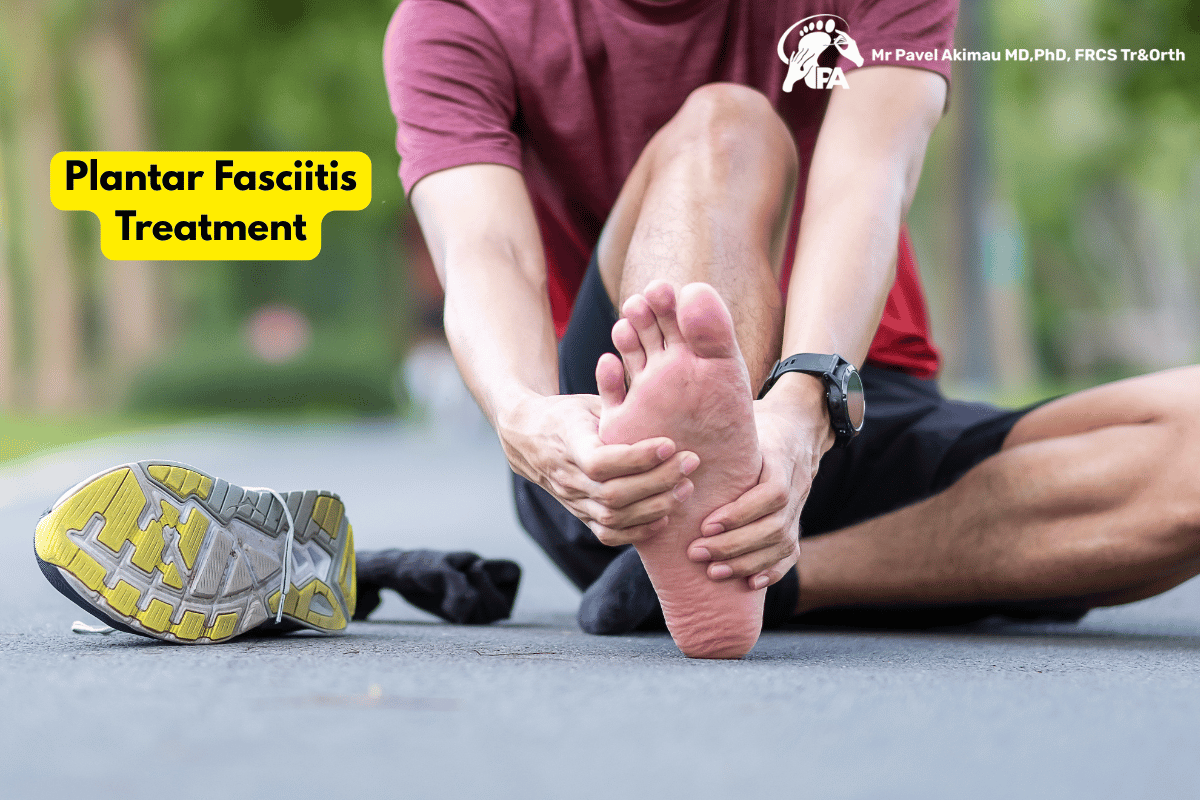
If your first few steps out of bed in the morning feel like standing on broken glass under your heel, and the pain eases off after a few minutes only to come back later in the day, there is a good chance you have plantar fasciitis. It is one of the most common reasons people walk into my clinic, and it is also one of the most frustrating problems patients live with because the standard advice stretch, change your shoes, give it time works slowly when it works at all, and the people who give that advice rarely explain what to do when it does not.
I am a consultant foot and ankle surgeon based in Staffordshire, with private clinics in Cheltenham and Bristol. I have spent eight years specialising in this part of the body, and heel pain is one of the things I see most often. This guide is the longer version of the conversation I have in clinic. It covers what plantar fasciitis actually is, why the morning pain is so distinctive, what works for it, what is largely marketing, and importantly what the surgical options are when the condition has lasted more than a year and conservative plantar fasciitis treatments have stopped helping. Most pages on this topic skim over surgery in a single line. Most patients I see have spent two years on shoe inserts before anyone explained the operation that could have settled the problem in months.
This article is for information only. It does not replace a face-to-face consultation. Severe heel pain, pain with significant swelling, or heel pain after a sudden injury should be assessed by a clinician rather than self-managed.
What this guide covers
- What plantar fasciitis actually is
- Why the morning pain is the classic clue
- Conservative plantar fasciitis treatment that works (and what does not)
- Shockwave therapy, injections and PRP — honestly assessed
- When surgery becomes a real conversation
- Gastrocnemius recession — the operation most patients have never heard of
- Plantar fascia release — the older operation and where it still has a place
- Recovery, return to running, and realistic timelines
- Frequently asked questions
What plantar fasciitis actually is
The plantar fascia is a tough band of fibrous tissue that runs along the sole of your foot, from the underside of the heel bone to the base of the toes. It works like a bowstring it supports the arch and absorbs load every time the foot strikes the ground. In someone who walks 10,000 steps a day, that is 10,000 cycles of tension through a single piece of tissue. Over time, in the wrong combination of biomechanics, training load and footwear, the tissue starts to fail at the point where it attaches to the heel.
Plantar fasciitis is the modern name for what most patients still call “heel pain” or, less accurately, a “heel spur.” Both names are misleading. The “itis” suggests inflammation, but when we look at biopsy specimens of the plantar fascia in chronic cases we usually find degeneration of the collagen rather than the classic signs of inflammation. The fibres are disorganised, there are areas of micro-tearing, and small new blood vessels and nerves are growing into tissue where they should not be. That is why anti-inflammatory tablets help only a little and only for the acute flare; the underlying problem is not really an inflammatory one.
Around one in ten people develop plantar fasciitis at some point in their life. It is most common between the ages of 40 and 60. Runners get it. People in standing occupations teachers, surgeons, retail workers, hospitality staff get it. People who have just had a significant weight gain get it. People with flat feet and people with high-arched feet both get it, for different reasons. It is, in short, one of the great equal-opportunity foot problems.
Why the morning pain is the classic clue
The single most useful question I ask a new patient with heel pain is what the pain is like first thing in the morning. With plantar fasciitis, the answer is almost always the same: the first ten or twenty steps after getting out of bed are excruciating, the pain eases off after a few minutes of walking, and then by the end of the day or after a long period of sitting and then standing up again the pain returns.
There is a reason for that pattern. While you sleep, the foot rests in a slightly pointed position, which lets the plantar fascia shorten. Those first few steps in the morning suddenly stretch the fascia back out. The micro-tears that the tissue is trying to heal overnight reopen, and the pain spikes. After a few minutes the tissue loosens and the pain settles. It is so characteristic that if a patient tells me their heel pain is constant all day and not worse first thing in the morning, I start thinking about other diagnoses a stress fracture of the heel, nerve entrapment, a fat pad problem because that pattern does not fit classical plantar fasciitis.
Other features that help me confirm the diagnosis in clinic:
- Tenderness on direct pressure to a specific spot on the inside of the heel
- Pain that gets worse with prolonged standing or after exercise, not during it
- Symptoms that have crept up over weeks rather than starting suddenly with an injury
- Often a recent change new job standing all day, a return to running after a winter off, a holiday spent walking in flat sandals
Imaging — do you need a scan?
Most cases of plantar fasciitis do not need a scan to confirm the diagnosis. An experienced foot and ankle clinician will diagnose it from the history and the examination in five minutes. I order imaging when the picture is atypical, when symptoms have lasted longer than six months without improvement, or when I am considering surgery. Ultrasound is the imaging of choice for the fascia itself it shows the thickness and any tearing clearly, and it can be done in clinic. MRI is reserved for when I want to look at the heel bone, the fat pad and the nerves around it as well.
X-rays often show a small bony spike on the underside of the heel a heel spur and patients sometimes arrive convinced this is the cause of their pain. It is almost never the cause. Heel spurs are present in around 20% of asymptomatic feet, and removing them surgically does not reliably treat plantar fasciitis. The spur is a marker of long-standing traction on the heel bone, not the source of the pain.
Conservative plantar fasciitis treatment that works
Most patients I see have already tried something before they reach me. For around 80% of cases, the right combination of conservative plantar fasciitis treatments done properly, for long enough will settle the problem within six to twelve months without injections or surgery. The pieces of that package, in roughly the order I would deploy them, are these.
Targeted stretching, done properly
Stretching is the single most effective home treatment, but “stretching” in this context usually means two specific stretches done many times a day, not a single calf stretch at the start of a run.
The first is a plantar fascia-specific stretch. Sit on the edge of the bed, cross the painful foot over the opposite knee, and pull the toes upwards firmly with your hand until you feel a stretch through the arch. Hold for ten seconds. Repeat ten times. Do it three times a day, and crucially do it first thing in the morning before you put your foot on the floor. That pre-stretches the fascia and reduces the morning spike. A published trial by Dr Benedict DiGiovanni in 2003 showed this single intervention outperformed a generic calf-stretching programme over two years.
The second is a calf stretch with the knee straight (for the gastrocnemius) and a second version with the knee bent (for the soleus). Three sets of thirty seconds on each leg, twice a day. Tight calves load the plantar fascia, and almost every plantar fasciitis patient I examine has tighter calves than they realise.
Footwear that supports the arch
Soft, supportive shoes with a modest cushioned heel are usually a better choice than flat trainers or sandals during an active flare. Drop-zero shoes, ballet flats, flip flops and worn-out trainers are the four most common footwear mistakes I see in clinic. A small heel raise inside the shoe around 9 to 12 mm reduces the load through the fascia and helps day-to-day comfort while you do the rehabilitation work.
Insoles and orthotics
A well-fitted insole supports the arch and reduces the strain on the fascia at heel-strike. Off-the-shelf insoles work for many patients brands like Superfeet, Vionic, Sof Sole or similar are reasonable starting points. Some patients benefit from custom orthotics made by a podiatrist after a proper foot assessment, particularly those with markedly flat or high-arched feet. I usually involve a podiatrist before I consider any surgical option, because if an insole can settle things for another six months that is six months of avoided procedure.
Night splints
A boot or sock that holds the foot in a slightly upward (dorsiflexed) position overnight keeps the plantar fascia stretched while you sleep, which means the first steps in the morning are not such a shock. The evidence is moderate. Patients either find them helpful and tolerable, or they find them uncomfortable and stop wearing them after three nights. Worth trying for two weeks; not worth persisting with if you cannot sleep in one.
Activity modification, not rest
Complete rest is almost never the right answer for a plantar fascia. The tissue needs gentle load to remodel. What we do reduce is the activity that is currently aggravating the tissue usually running, hill walking, or long periods on hard floors in unsupportive footwear. Swimming, cycling and elliptical work are usually fine and keep cardiovascular fitness up while the foot heals.
Short courses of anti-inflammatories
Oral anti-inflammatories like ibuprofen or naproxen, taken for short defined periods (a week or two during an acute flare), help with day-to-day pain and let you continue the rehabilitation. They will not cure the underlying tissue problem, and taking them long-term is not recommended. I never prescribe them as the only treatment; they are an adjunct, not a plan.
What I do not recommend
- The various “miracle” copper-infused socks, magnetic insoles and similar products sold online. None has credible evidence.
- Walking it off when the pain is severe. Pushing through a hot fascia delays healing.
- Aggressive deep-tissue massage to the painful area, particularly in the first few weeks. It often makes things worse, not better.
Shockwave, injections and PRP — my honest view
If three to six months of properly delivered conservative treatment has not settled the problem, the next layer of options comes into play. I will be straight with you about how each of them performs.
Extracorporeal shockwave therapy (ESWT)
Shockwave is a focused acoustic pulse delivered through the skin, usually across three to six weekly sessions. It is non-invasive, has no real downtime, and the published evidence for plantar fasciitis is genuinely good several meta-analyses now place success rates in the region of 60–80% for chronic cases. NICE has produced guidance supporting its use for stubborn plantar fasciitis. It is one of the few “new” plantar fasciitis treatments I am genuinely positive about, and I refer patients for it regularly. The main caveat: it is rarely available on the NHS routinely, so for most patients it is a private treatment, and it is not a substitute for the stretching programme the two work best together.
Steroid injections
A targeted steroid injection into the painful spot under ultrasound guidance can produce rapid and dramatic short-term relief. The reason I use steroid injections sparingly is that they carry two real risks: rupture of the plantar fascia (around 2–6% in published series), and atrophy of the fat pad under the heel, which leaves the patient with a different and harder-to-treat pain afterwards. I will offer a single carefully placed steroid injection in selected patients typically those who need short-term relief for a specific reason (a holiday, a wedding, a return to work) but I do not use repeated injections as a treatment strategy.
Platelet-rich plasma (PRP)
PRP involves taking a sample of your own blood, concentrating the platelets, and injecting them into the plantar fascia under ultrasound guidance. The theory is that the growth factors stimulate tendon-like healing. The evidence is genuinely mixed some trials show PRP outperforms steroid at six months and twelve months; others show no meaningful difference. It is not cheap, it is not on the NHS for this indication, and I discuss it honestly with patients: it may help, it may not, and the body of evidence is not yet strong enough for me to push it as a default option.
Dry needling and prolotherapy
Both have proponents and modest evidence. I do not use them in my own practice, and I would not push back if another clinician offered them, but they are not where I would direct my efforts first.
When surgery becomes a real conversation
Most patients with plantar fasciitis do not need surgery. The figure in published series is consistent: around 90–95% of cases settle without an operation, given enough time and the right conservative work. Of the remainder, some find their pain at a level they can live with and opt to continue managing it; some come to surgery.
The conversation about surgery becomes serious in my clinic when all of the following are true:
- Symptoms have lasted more than 12 months despite a properly delivered programme of stretching, footwear changes, orthotics and at least one course of shockwave therapy
- The pain is significantly affecting work, sleep, exercise or quality of life
- Imaging (ultrasound or MRI) confirms the diagnosis and rules out other contributing problems
- The patient understands the trade-offs of an operation and the realistic recovery
The patients who come to surgery for plantar fasciitis tend to fall into two groups. The first are people who have done absolutely everything right stretching, insoles, shockwave, the lot for over a year and still cannot walk without pain. The second are people whose calves are so tight that no amount of stretching has moved the needle, and the underlying mechanical loading on the fascia is simply not going to change without an operation. The two operations available are very different, and the second of them is one most patients have never heard of.
Gastrocnemius recession — the operation most patients have not heard of
This is the operation I most often recommend for stubborn plantar fasciitis, and it is also the one almost no patient-facing article explains properly. The Mayo Clinic page mentions surgery in a single line; the Cleveland Clinic page barely mentions it at all; the NHS page does not discuss it. That is a real gap, because the evidence behind this procedure is now strong and it has a much easier recovery than the older operation it has largely replaced.
The reasoning behind it
The plantar fascia and the calf muscles are mechanically linked. They pull on the same bone (the heel) from opposite ends. If the calf complex is too tight specifically the gastrocnemius portion, the larger of the two calf muscles that crosses both the knee and the ankle it constantly tugs on the heel bone, which in turn drags on the plantar fascia. Stretching helps in many patients, but in a subgroup the gastrocnemius is so tight that no amount of stretching will lengthen it enough to take the load off the fascia.
In those patients, lengthening the muscle surgically by a small amount removes the mechanical driver of the problem. The plantar fascia, no longer being constantly tugged on, has the chance to remodel and the pain settles. This is not new the link was first described decades ago but it is only in the past 10–15 years that the operation has become routine for plantar fasciitis, supported by good outcome data.
How the operation works
It is a day-case operation, done under general or regional anaesthetic. A small incision around 3–4 cm is made high up on the inside of the calf, just below the back of the knee. Through that incision, the surgeon identifies and divides a small band of tendinous tissue at the lower edge of the gastrocnemius muscle. The muscle below remains intact and continues to do its job; the lengthening is small but enough to take the chronic tension off the heel.
The operation usually takes about 20 to 30 minutes. There is no implant or hardware. The skin is closed with absorbable sutures and a simple dressing. There is no plaster cast.
Recovery and what to expect
Patients walk on the operated leg the same day, in normal shoes. There is no boot, no crutches in most cases, and no restriction on weight-bearing. Most patients drive within a few days. Office work is possible from the end of the first week; jobs that involve a lot of standing are usually fine by the third week. Return to running and high-impact sport at 8 to 12 weeks.
The thing patients are usually surprised by is that the heel pain does not always disappear the day after surgery. The plantar fascia has been irritated for months or years it takes a few weeks to settle once the load comes off it. Most patients describe a clear and progressive reduction in heel pain over the first six to eight weeks, with continued improvement for several months afterwards.
Success rates and limitations
The published success rate for gastrocnemius recession in carefully selected plantar fasciitis patients sits around 90–95%. The selection matters the operation works best in patients with a documented gastrocnemius contracture on examination, which is something I check specifically in clinic with the Silfverskiöld test. In patients without that finding, the operation is less reliable and I would not recommend it.
Specific risks are uncommon but real and need discussing in clinic: temporary calf weakness (almost always recovers fully within a few months), a small risk of injury to the sural nerve in the calf (under 1% in experienced hands), wound healing problems (rare), and the general risks of any operation. I discuss these in detail with every patient I consent for the procedure.
Plantar fascia release – the older operation, and where it still has a place
The traditional operation for stubborn plantar fasciitis was a direct release of part of the fascia itself, sometimes called a partial plantar fasciotomy. The surgeon makes an incision on the inside of the heel and divides the inner third of the plantar fascia, which reduces its tension. There is also an endoscopic version (keyhole) of the same operation, done through two tiny incisions either side of the heel.
It works published success rates sit between 70% and 90% but it has fallen out of favour as the first-choice operation for two reasons. First, releasing the fascia changes the architecture of the foot arch and can produce a long-term flattening of the arch and lateral foot pain in around 10–20% of patients. Second, recovery is longer than gastrocnemius recession typically several weeks in a boot, with full return to activity at three to six months. For patients without a gastrocnemius contracture, or for those who have already had a gastrocnemius recession that did not fully settle their symptoms, plantar fascia release remains a perfectly reasonable operation. It is not the first one I reach for, but it has not been retired.
Recovery, realistic timelines and return to running
This is the question patients ask most often, and I have learned to be specific rather than vague. These are the timelines I quote in clinic, based on what I see in my own patients.
Conservative plantar fasciitis treatment
- Weeks 1–2: stretching programme starts. Pain often slightly worse for the first week as the tissue adapts.
- Weeks 4–6: morning pain usually starts to ease. Most patients are noticeably more comfortable on day-to-day walking.
- Months 3–6: most patients have either resolved or substantially improved. Return to running is reasonable from around month 3 if pain has settled.
- Months 9–12: this is the point at which patients who have not improved should be reassessed for shockwave or surgical options.
After shockwave therapy
Patients typically have three to six weekly sessions. Improvement usually starts to show four to six weeks after the final session. Full benefit is judged at the three-month mark. There is no real downtime between sessions.
After gastrocnemius recession
- Day of surgery: walking in normal shoes.
- Week 1: gentle home activity, work from home if sedentary.
- Weeks 2–3: return to most normal activity, light gym.
- Weeks 4–6: heel pain meaningfully improving.
- Weeks 8–12: return to running and impact sport.
After plantar fascia release
- Weeks 0–2: walker boot for protected weight-bearing.
- Weeks 2–6: transition to supportive trainers with insole.
- Months 3–6: return to running and high-impact activity.
Two predictors of who does well separate the patients in my experience. The first is consistency the people who do the stretching programme properly, every day, for the full duration. The second is realistic expectations. The plantar fascia is a piece of tissue that has been under chronic strain for a long time. It does not recover in a fortnight. Anyone who promises otherwise is not being straight with you.
Frequently asked questions
What is the fastest plantar fasciitis treatment?
There is no genuinely fast cure for plantar fasciitis. The fastest path to lasting relief is starting the right combination of treatments specific stretching, supportive footwear, an insole, activity modification within the first few weeks of symptoms rather than waiting six months hoping it will settle on its own. The patients who do best are the ones who treat the problem early. A steroid injection produces the most rapid relief of any treatment, but the relief is often short-lived and the risks make it the wrong default option.
Will plantar fasciitis go away on its own?
In some patients, yes around half of cases settle within a year even with minimal intervention. The other half persist and become harder to treat the longer they go on. The honest answer is that hoping it will go away is a strategy that works some of the time, but it is not the strategy I would choose if it were my heel.
Are heel spurs the cause of plantar fasciitis?
No. Heel spurs are present in around 20% of asymptomatic feet and are a marker of long-standing traction on the heel bone, not the source of the pain. Surgery to remove the spur alone almost never resolves plantar fasciitis. The spur is the smoke, not the fire.
How long do plantar fasciitis treatments take to work?
Conservative measures need to be done consistently for three to six months before judging whether they have worked. Shockwave therapy is judged at the three-month mark from the end of treatment. Surgery produces clearer results within weeks to a few months, depending on the operation. The most common mistake patients make is changing treatments every two weeks because they have not seen an immediate effect.
Can I run with plantar fasciitis?
During an active flare, running usually makes the fascia angrier and slows healing. Once symptoms have settled and you can walk without pain, a gradual return to running starting with run-walk intervals on soft surfaces, in well-cushioned shoes is reasonable. Going straight back to your pre-symptom training load is the single most common cause of recurrence I see.
Is plantar fasciitis surgery available on the NHS?
Yes, although access is variable and waiting lists are often long. Many NHS trusts will only consider surgery after a documented twelve months of failed conservative care, which in practice means seeing a GP, a physiotherapist, then a specialist clinic before any operation is offered. Private treatment shortens the pathway considerably. The operation itself is the same in both settings.
How much does private plantar fasciitis surgery cost in the UK?
Self-pay packages for gastrocnemius recession or plantar fascia release typically fall in the range you would expect for any modern foot and ankle day-case operation. The fee usually bundles the consultation, the operation, the anaesthetic, the hospital stay and post-operative follow-up. All major insurers (Bupa, AXA, Aviva, Cigna, WPA, Allianz, Healix) cover surgical plantar fasciitis treatment when conservative care has failed and the indication is documented. Specific self-pay options for my practice are listed on the prices page of this website.
When should I see a foot specialist rather than my GP or physio?
Most plantar fasciitis can and should be managed initially by a GP and a good physiotherapist. Referral to a foot and ankle specialist is reasonable if symptoms persist beyond six months despite a proper rehabilitation programme, if the diagnosis is uncertain, if shockwave or PRP is being considered, or if surgery is on the table.
If you are stuck with plantar fasciitis
If you have been managing this problem for more than six months and the standard advice is no longer moving the needle, a proper consultation is worth the time. An assessment takes about thirty minutes examination, an in-clinic ultrasound if needed, a clear conversation about what is going on, and a written treatment plan that includes the options most patients are never offered. There is no obligation to go any further than the consultation.
I see patients privately at Nuffield Health North Staffordshire Hospital in Newcastle-under-Lyme, Nuffield Health Cheltenham Hospital, and North Bristol Private Hospital. Insurer and self-pay both accepted. Book a consultation through the contact page of this website, or call the rooms directly.
About the author
Mr Pavel Akimau is a Consultant Trauma and Orthopaedic Surgeon at University Hospitals of North Midlands NHS Foundation Trust, one of the busiest major trauma centres in the UK. He specialises in foot and ankle surgery with a particular focus on minimally invasive techniques and has introduced four MIS procedures to the North Midlands region. He holds an MBBS, a PhD in Medical Sciences from Osaka University, and completed his CCT in Trauma and Orthopaedics on the South Yorkshire rotation in 2016. He has been a consultant since 2021 and runs private clinics in Staffordshire, Cheltenham and Bristol.
GMC: 6100148. Member of the British Orthopaedic Foot and Ankle Society (BOFAS). External profiles: National Joint Registry, Nuffield Health, Bupa, Doctify.
References and further reading
- DiGiovanni BF, et al. Tissue-specific plantar fascia stretching exercise enhances outcomes in patients with chronic heel pain. J Bone Joint Surg Am, 2003.
- Monteagudo M, et al. Plantar fasciopathy: a current concepts review. EFORT Open Reviews, 2018.
- Maskill JD, et al. Surgical management of chronic plantar fasciitis with gastrocnemius recession. Foot Ankle Int, 2010.
- Lou J, et al. Effectiveness of extracorporeal shockwave therapy for plantar fasciitis: systematic review and meta-analysis. Int Wound J, 2017.
- National Institute for Health and Care Excellence (NICE) guidance on extracorporeal shockwave therapy for refractory plantar fasciitis.
- British Orthopaedic Foot and Ankle Society (BOFAS) patient information.